Anchor Hotel – chapter 2

It has been a while since my last entry. We anchored out two weekends back, in our usual spot in le Grande Anse. There were no anchoring mishaps this time as Chris and I were more conscious of proper anchoring technique. I realize now that with our previous, smaller boats, the Tanzer 22s, we may have gotten away with poor anchoring technique. I find that I devote a lot of free thought to anchors and anchoring, lately. I am constantly perusing on-line chandlery catalogues, pricing anchors and rodes. I also read on-line articles comparing anchor types and techniques, as well a review articles on anchoring in back issues of my many sailing magazines. The more I learn about anchors and the hazards and pitfalls anchoring, the more I worry about the safety of my crew (the dear wife) and vessel. Crykie, ignorance in this area definitely was bliss!

In any case before we depart on the big cruise at the end of the month I will be adding a 7-10 lbs Bruce anchor to Rêverie’s ground tackle. Among the many financial “death by a thousand cuts” outlays I must make over the next few weeks to prepare her, the boat, for our cruise up to the Thousand Islands. Ironically, the Thousand Islands area is just 1-1/2 to 2 hours drive from our home. We hope to be gone for about a week and half. As fast as it might feel closed-hauled with the rails in the water and force of the wind on the helm, sailing is not about getting there on any kind of schedule. I have a t-shirt from the folks at Good Old Boat magazine, my favourite, a gift from Chris and Lynda. The image on the shirt is a wandering sailboat with the inscription “Are we there yet? Who Cares?” This is a great expression of a simple philosophy connected with sailing and other traditional skills – it is the journey, not the destination that matters most.

I digress. We got Rêverie and Drifter safely anchored, and went for a swim in the still cool lake. The cold spring has delayed the warming of the water by a week or two. As we swam around our rafted-up boats, we encountered both warm and cold patches of water. It is still early in the summer, so the weed fronds have not yet reached up to the surface of our shallow lake. I was wishing that I had my mask and snorkel aboard as I wanted to dive beneath the boat and check the anchor line and keel, because at the time I think it is something that cruisers do while at anchor.

Dinner was wonderful; oysters with our cocktails, hotdogs and chicken (I can’t eat hotdogs) on the barbeque, accompanied by green and potato salads. All washed down with a nice seasonal Rosé.

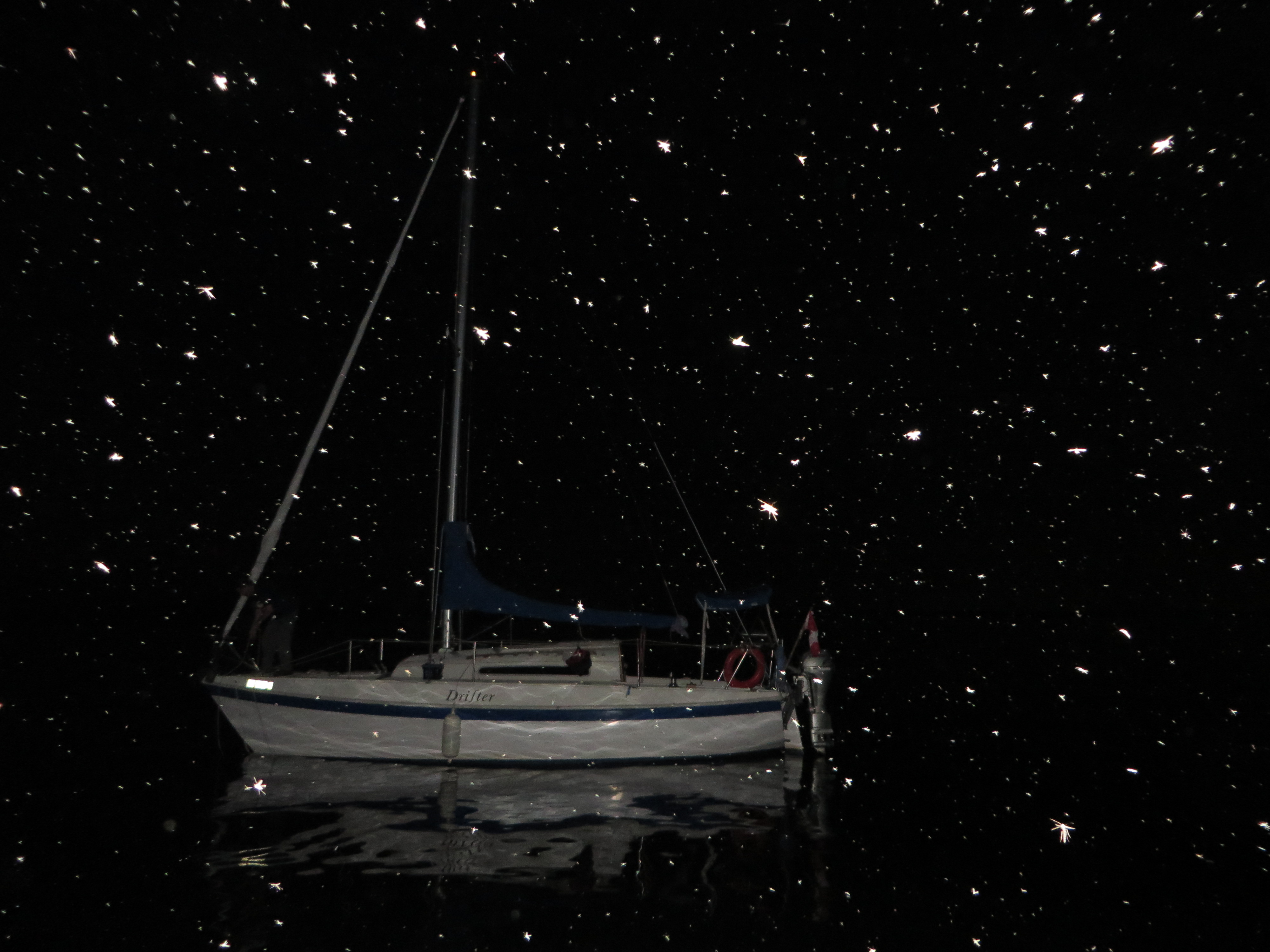
As we were de-rafting and rechecking our anchor lines (an ever present concern), Vi snapped a few shots of Chris and I busy with lines. However, she captured more than boats and tars, the images below are just two of the many “anchored in the stars” images she shot.
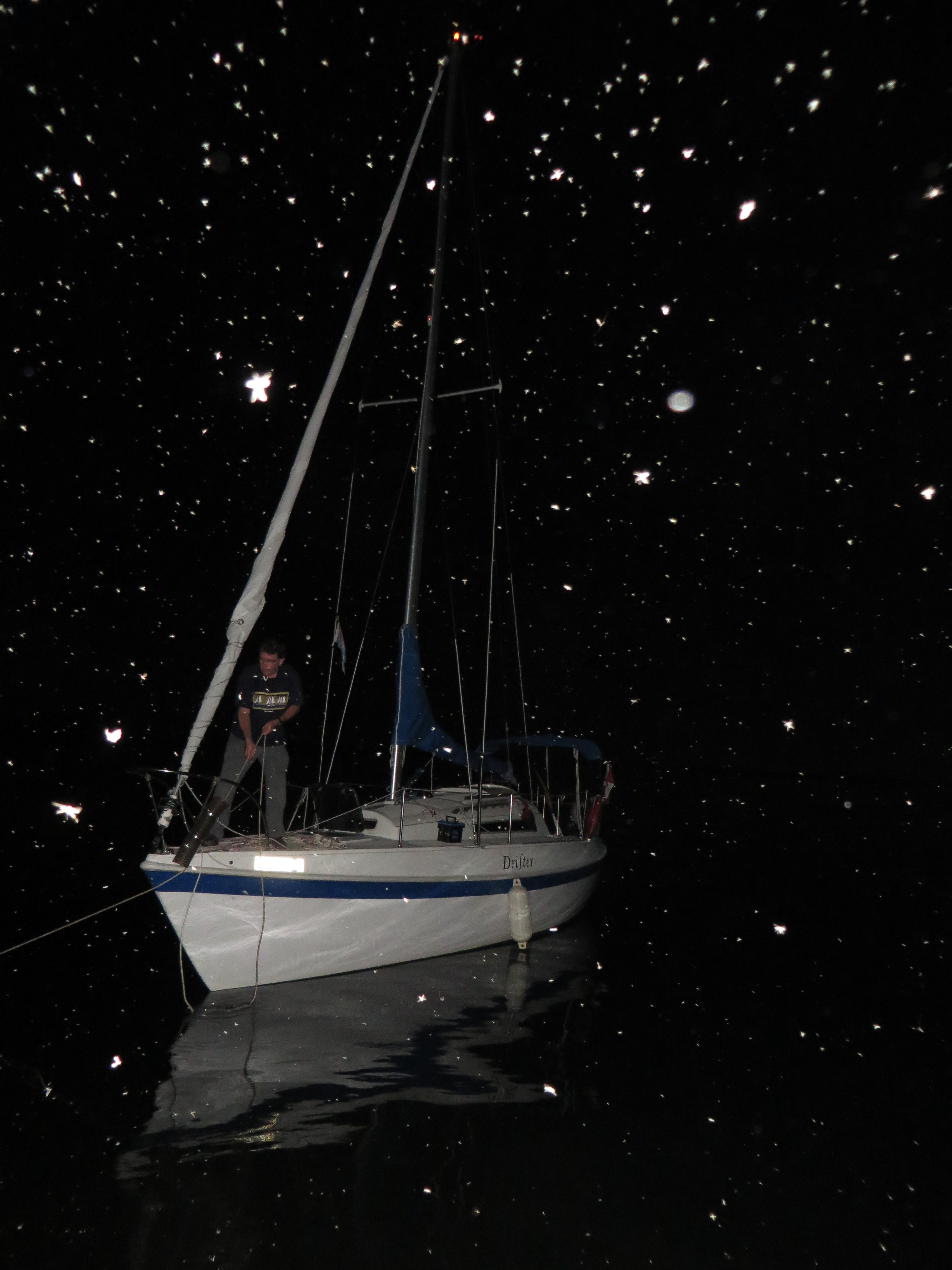
Anchoring in the Milky Way.

At anchor in the stars.

The next morning was wonderfully still and clear. The lake was flat and resplendent in summer colours while we munched on our toast with jam and Scottish marmalade and sipped our morning tea; talking quietly, respectful of the dawn.
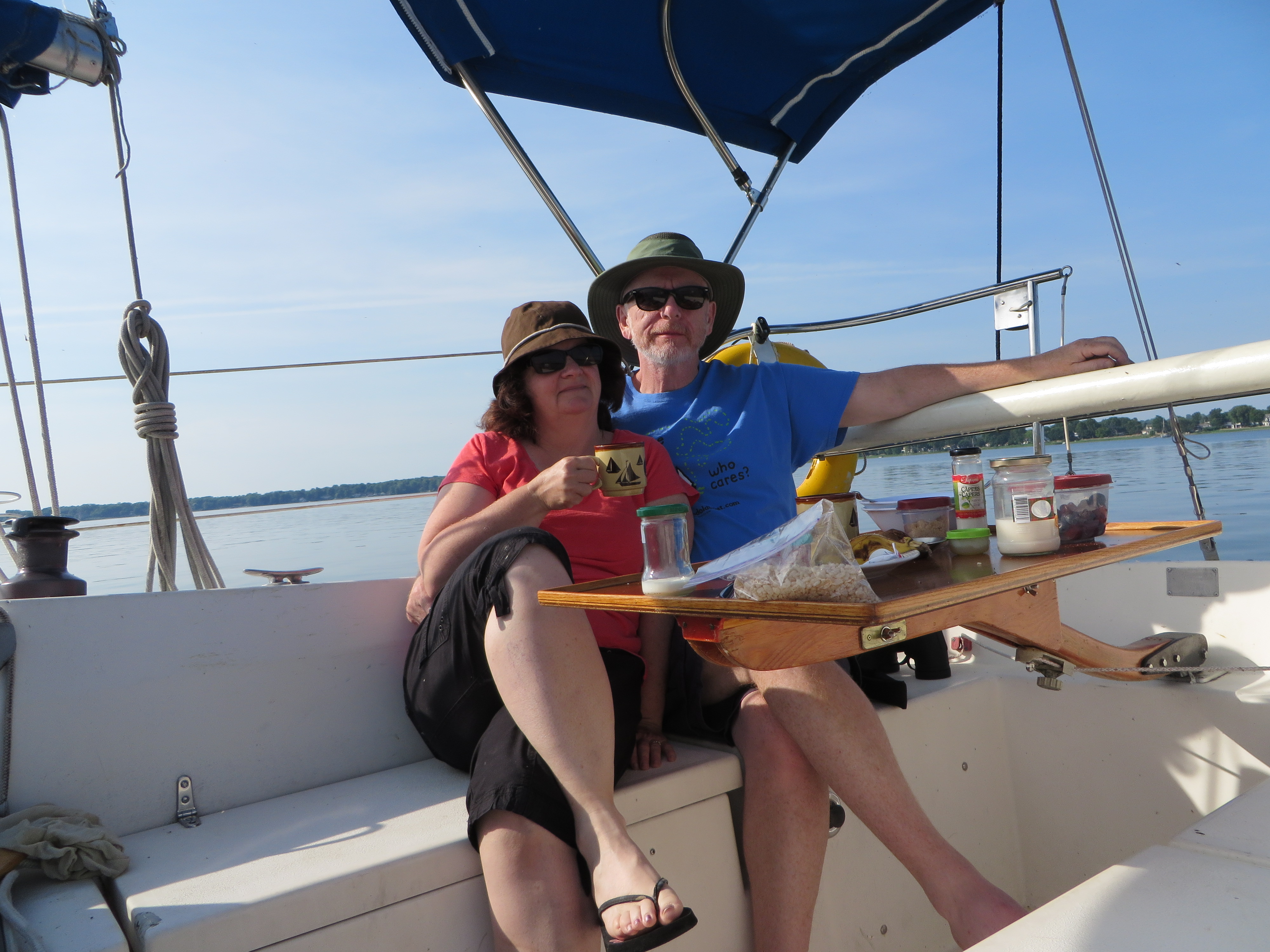
Morning tea.

We try to take pictures of each other’s boats. This is Drifter at rest:
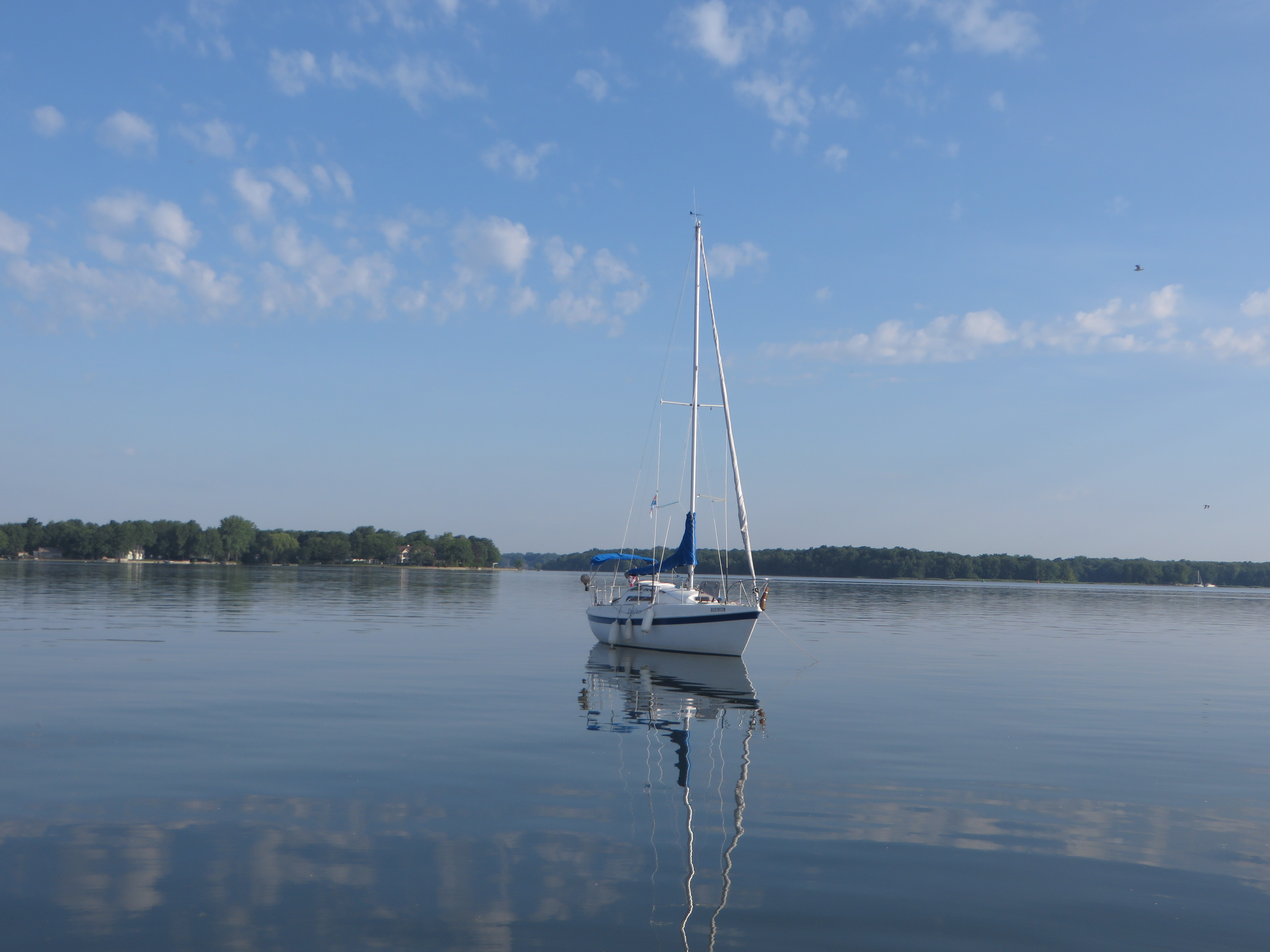
Drifter at rest.

While we were getting set up for breakfast we heard some fishermen heading out across the bay. Vi captures the timeless activity and camaraderie of fishermen setting out in the wee hours of the morning.
Fishermen

After breakfast, we weighed anchor and tried our asymmetrical spinnaker for the first time. The wind was East-Southeast, so we were unable to do much beyond tack back and forth across the bay, but it was nice to know that Vi and I could fly this beautiful downwind sail without too much trouble. I played with and organized the many lines required, and Vi was at the helm. After a bit, we socked and bagged the kite, rolled out the genoa and headed out of the bay to round Dowker Island. It was a pleasant sail home, with light winds and the occasional puff to move us along. I like these morning sails with my sweetie, as we are learning to work Rêverie in tandem, Vi at the helm and me tending the sails.

Making a whisker pole

Where we sail the winds are often light and always fickle. This is river sailing. There isn’t much we can do about the fickle nature of the winds, but we can look for ways to maximize sail performance in light winds. I am far from being an expert in this area, but I have found that poling out the genoa when sailing off the wind, in light winds, allows the sail to stay full and drawing. Since Rêverie did not come with a whisker pole, I need to either shell out big bucks for a ready-made one at the local chandler or, the more likely choice, fabricate one from bits and pieces. I am going the fabrication route. Rêverie has a loop on the mast to accept the inboard end of a pole with a snatch type hook, so that is one less worry.

Two seasons back, while out sailing on a fall day with my friend Chris, we came across a whisker pole floating vertically in the middle of the lake. A two foot length of the pole was visible above the water. The pole seems to have been at the bottom of the lake and the low water levels and probably a passing mouth-breathing power boater combined to free it from the murky depths (not so deep depths in our lake). We hooked it with the trusty boat hook and brought it aboard because we felt it posed a threat to navigation. When we hoisted it aboard it expelled a puff of noxious gas that it had transported from the bottom of the lake. We persevered. After a brief discussion about salvage etiquette, Chris insisted that I had salvage rights to the pole since I am the owner of the salvage craft. I suspect the foul odour that continued to emanate from the pole might have influenced this opinion.

This, now less smelly, pole with its snatch hooks on either end will provide the keys parts for my home-made whisker pole. The snatch hooks seem to be the expensive parts of a standard non-carbonfibre pole. As a quick check with the afore-mentioned chandler would indicate that I could not justify the costly purchase of these end-pieces to the admiral. Luck comes in many forms, some more smelly than others.

The pole itself is too short for use on my 27 foot boat, but fortune once again favoured me with a convenient and free alternative. We took out our old above-ground pool last fall because our sons are grown and it does not get used often enough to justify the work required to maintain it. The skimmer handle, which is long and adjustable will be fitted with a snatch hook at one end and small bolt/pin at the other. The pin end will be used to hook into the clew of the genoa and the snatch hook will attach to the mast.

I am still working out the technical details of this Franken-whisker pole, but I will try to take some pictures to share the fabrication process and, hopefully, successful use of this pole.

Anchor Hotel 2014

We anchored out this past weekend in the company of our good friends Lynda and Chris. The original plan was to sail over to the Beauharnois locks on the St-Lawrence Seaway, and ascend up to Lac St-Francois for weekend of gunk-holing. Equipment issues on both our Rêverie and Drifter, Lynda’s and Chris’ Tanzer 26, caused us to reconsider our plans. Having to change the heads on both boats an hour before departure did not encourage us to wander too far from home.

Our revised plan was to sail, or motor, over to our usual anchoring spot in the Grande Anse on the east side of Ile Perrot. This is a large bay with good holding that offers good protection from the prevailing west wind, as well as some shelter from the south and north winds.

We left around 6 pm and motored over to the anchorage as the wind had died out and we wanted to get set for rafting up together and a late dinner and drinks. Our thirty year-old motor, a 7.5 hp Yanmar 1GM diesel, performed well during the trip to the anchorage. The previous owner took good care of this motor. It certainly neither looks nor performs like an old motor. I plan to continue taking good care of this baby. To that end, I read Nigel Calder’s excellent Marine Diesel Engines over the winter and plan to take a marine diesel maintenance course this fall. There will be more on my thoughts about Diesel engines and the course in upcoming posts.

Our anchoring adventure took a turn for the worse when Lynda was injured while playing out the anchor line. She suffered a painful injury to her hand when it was caught in the rode. She bravely weathered the pain and with the help of applied ice and imbibed wine, was able to enjoy the lovely evening on the lake.

After rafting up without incident, we had a pleasant evening of good food from the barbecue and pre-prepared from the kitchens of Vi and Lynda, aboard Drifter. As usual some wine was spilled, which I was able to pin on Lynda given her degraded dexterity. The Grande Anse offers a wonderful view of Montreal in the distance, and the expanse of Lac St-Louis, which we enjoyed while munching on goodies and sipping wine we managed to keep in our glasses and away from the thirsty deck.

Our post prandial slumber was interrupted when Vi detected a new noise from her berth in the forecastle. She called back to me to report a “new noise.” I went up on deck to investigate and found that our anchor line was tangled with Drifter’s. Chris also came up on deck at this point, and together we got them untangled. I was cold up on deck at three am, and the deck was slippery. It took several tries to get the boats untangled and Vi also assisted with fendering while Chris and I concentrated on the lines. It was difficult to get back to sleep afterwards as the anchorage was a bit rolly and our adrenaline levels were elevated.

The next morning we slept later than is usual while at anchor. We enjoyed a simple breakfast of oatmeal, toast, marmalade, fruit and tea prepared in our boat’s small but usable galley.

After breakfast, we once again untangled the anchor rodes and weighed anchor. The sail back to the club was very pleasant. Winds were mostly light, but with Vi at the helm and me on the sheets, we manage to coax enough speed to move along at around 3.5 knots. While the wind did vary in both speed and direction, we only had one big gust that knocked us on our ear and forced us to crash tack, as the wind came around from the opposite side.

We continued to have head issues while at anchor, which required more work and additional outlay of funds, but I will cover that in another post.